I am in Germany where the keys are located in different places on the keyboard than I'm used to.
I have no email here but this terminal is just accross from the hotel so I will check comments.
Coffee is verz good here and people v.friendy if only I could stop trying to talk to them in French.
Tuesday, 10 July 2012

Friday, 6 July 2012
Character Songs: Nightingale
Detective Chief Inspector Thomas Nightingale
"I'll protect you from the hooded claw...
Keep the vampire from your door."
Thursday, 5 July 2012

Monday, 2 July 2012
At Last The Truth! We're Going To Need a Bigger Truck!
I tried being carefree but all that resulted was a list of influences in no particular order - those halcyon days are over, ORDER must be imposed.
 N.K. Jemison recently asked: But, but, but — WHY does magic have to make sense?
To which the answer, of course, is that the magic works the way that
the magic needs to work to further the aims of your story. Genre is a description not a prescription and in the final analysis the trappings of a story are not what sets the good stuff apart from the bad.
In Rivers of London I decided that while I understood the way magic worked, I am the creator after all, the practitioners of magic both Newtonian and natural, had to work within an incomplete and, in some cases, erroneous theoretical base.


 Lyonesse III: Madouc

(1) They weren't all giants. The best that could be said of some of them was that they were dwarves with step ladders but they tried hard and that's the main thing.
N.K. Jemison recently asked: But, but, but — WHY does magic have to make sense?
To which the answer, of course, is that the magic works the way that
the magic needs to work to further the aims of your story. Genre is a description not a prescription and in the final analysis the trappings of a story are not what sets the good stuff apart from the bad.In Rivers of London I decided that while I understood the way magic worked, I am the creator after all, the practitioners of magic both Newtonian and natural, had to work within an incomplete and, in some cases, erroneous theoretical base.
It's
still possible to achieve great things with an erroneous theory.
Bazalgette's sewer system in London was built on the understanding that
bad smells caused disease but still had the required effect of ridding
the city of cholera. And bad smells as well.
But these ideas didn't just pop into my head like a slightly
irritating know-it-all prophecy or the warrior in Jet and Gold they were
influenced by the work of the giants(1) that came before me.
Making Magic Work
Any sufficiently advanced technology is indistinguishable from magic. - Arthur C. Clarke(2)

The Incomplete Enchanter
L. Sprague de Camp and Fletcher Pratt's 1941 book of magic and dimension hopping was the first time I was exposed to the idea that magic might be determined by the underlying rules of the universe.
In the first novella 'The Roaring Trumpet' our hero, transported to a world of Nordic myth, confidently steps forward to slay a dragon with his pistol only to find that it doesn't work. There's nothing mechanically wrong with his gun it's just that in this particular universe the chemical reactions that facilitate firearms don't work.
When you're 11 years old this is heady stuff but more importantly it teaches you to think critically about how magic will fit into your world.

A Wizard of Earthsea
Ursula K. Le Guin once said in an interview that she wrote A Wizard of Earthsea (1968) because she'd always wondered where all the wizards that populated fantasy actually learnt their magic. The answer is the school on Roke which is, as far as I know, the first wizarding school in fiction.
As Jemison points out in her blog that the magic they learn at Roke is more than memorising the true names of things and that being both conditional and situational was much more an art than a science. And while it's explicit that 'rules change in the reaches' I always got the impression that Ursula knew why(3).

Ars Magica
It's been just under thirty years since I played an RPG in earnest and yet I still have several shelves full of them. I can claim a certain utilitarian value for things like the GURPS historical source books and Call of Cthulhu supplements and some of them are beautiful artefacts just in themselves.
But the truth is that you'd be hard pressed to find a more concentrated form of ideas anywhere else. For writers of a certain bent they are the crack cocaine of research materials. You know it might be bad for you but the hit is so...so... fast.
It was Ars Magica's use of Latin words to describe the building blocks of Hermetic magic was a direct inspiration for the formae Nightingale teaches Peter in Rivers of London. This set me thinking about what exactly is it you are doing in your brain when you speak a magic spell and the idea that the words were abstract labels, like musical notes, whose purpose was to regulate the way you formed the shapes in your mind.
 The Science of Discworld II
The founding of the Folly and the codification of magic by Isaac Newton owes itself to a throwaway remark in this book. In it they discuss Newton's interest in religious philosophy and alchemy, which the writers make clear is a waste of Newton's time, one of them, in the footnote, does point out that if anyone in the history of science was going to discover the principles of magic it was Isaac Newton.
A light-bulb went off in my head and voila. The moral is be careful what you say in your footnotes lest some jobbing writer rebuild his entire career on the basis for your throwaway remark.
But the truth is that you'd be hard pressed to find a more concentrated form of ideas anywhere else. For writers of a certain bent they are the crack cocaine of research materials. You know it might be bad for you but the hit is so...so... fast.
It was Ars Magica's use of Latin words to describe the building blocks of Hermetic magic was a direct inspiration for the formae Nightingale teaches Peter in Rivers of London. This set me thinking about what exactly is it you are doing in your brain when you speak a magic spell and the idea that the words were abstract labels, like musical notes, whose purpose was to regulate the way you formed the shapes in your mind.

The founding of the Folly and the codification of magic by Isaac Newton owes itself to a throwaway remark in this book. In it they discuss Newton's interest in religious philosophy and alchemy, which the writers make clear is a waste of Newton's time, one of them, in the footnote, does point out that if anyone in the history of science was going to discover the principles of magic it was Isaac Newton.
A light-bulb went off in my head and voila. The moral is be careful what you say in your footnotes lest some jobbing writer rebuild his entire career on the basis for your throwaway remark.
Making Magic Wild
Madouc performed a prim curtsey, and Shimrod bowed. ‘It is a pleasure to make your acquaintance. I do not meet princesses every day!’
Madouc gave a rueful grimace. ‘I had rather be a magician, and see through walls. Is it difficult to learn?’
‘Quite difficult, but much depends upon the student. I have tried to teach Dhrun a sleight or two, but with only fair success.’
‘My mind is not flexible,’ said Dhrun. ‘I cannot think so many thoughts at once.’
'That is the way of it, more often than not, and luckily so,’ said Shimrod. ‘Otherwise, everyone would be a magician and the world would be an extraordinary place.’
Madouc considered. ‘Sometimes I think as many as seventeen thoughts all together.’
 Lyonesse III: Madouc
Magic in Jack Vance's fantasy has always been exotic, extraordinary and deliberately obtuse. Vance makes it clear that magic has rules, lots and lots of rules, it's just that they are as vague, contrary and fantastical as the strange beings that practise it.
As with much else in a Vance novel success in magic is as much a question of negotiation and verbal dexterity as it is adherence to formulas. From Vance I not only took the notion that the magic of the genius loci, and others, was wilder and more fabulous than the structured magic of the newtonians but also a looseness of definition to avoid that 'got it out of the monster manual' feel.

The Lord of the Rings
By some Oxford professor whose name escapes me(4). The magic in Tolkien's work is subtle and often works at an intangible, spiritual level. As when the Black Riders are driven into the river by Glorfindel(5) despite there being no physical battle as such or the lack of distinction by the elves between 'craft' and 'magic'.
I drew upon both aspects for Rivers of London where craft lies at the heart of human magic and the power of the Rivers is often intangible and difficult to distinguish from the natural world.
Before anyone asks I have no intention of explaining that in any more detail - spoilers. Let's just say that human agency and activity is a key part of the way magic is produced.

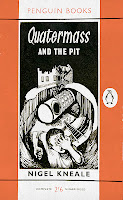
Quatermass and the Pit
By Nigel Kneale. Some of you are no doubt saying - 'But Ben, surely this is science fiction not fantasy?' Which is what makes it interesting. In this story of man's discovery that his evolution has been shaped by aliens some three million years before the release of Ridley Scott's Prometheus Kneale artfully weaves together science and folklore in a way far beyond that of your purveyor of tired second hand tropes(6).
At one point the legend of the wild hunt is explicitly linked to the culls of ancient Mars and then to the increasing mob violence of an overpopulated contemporary Earth. In this instance science (or rather biology) becomes the instigator of the wild magic itself.
Once again this blog has got too long and will be continued in next weeks instalment - Now At Last! I Can't Believe I Don't Get A Bulk Discount.
(1) They weren't all giants. The best that could be said of some of them was that they were dwarves with step ladders but they tried hard and that's the main thing.
(2) The corollary; that any sufficiently advanced magic is indistinguishable from technology, was coined independently by me in 1988 for the Doctor Who story Battlefield - only it got cut from the broadcast version and I can't find my scripts. You're just going to have to take my word for it.
(3) In fiction it is entirely sufficient for an author to give an impression that they know what what they're doing regardless of of whether they do or not - the exact opposite of Engineering.
(4) Definitely not the one who wrote the Narnia books though.
(5) I can't believe his name was preprogrammed into my factory standard spell checker.
(6) However beautiful it looks.
Sunday, 1 July 2012
I Woz Robbed by Jordan
 Whispers Under Ground has made it into the Sunday Times Bestselling Hardback Fiction list at number 4.
I was beaten to 3rd Place by Katie Price by dint of her selling more books than me. I'm not sure how that works, perhaps she gets a head start.
Anyway here is proof...
Friday, 29 June 2012
Monday, 25 June 2012
Off On Book Tour
I'm off to flog the book around the country (or at least those bits that Gollancz will stump up to send me to) so meanwhile here is a thoughtful piece on just how hard working your London author is.
'Hampstead wasn't good enough for you was it? You had to go poncing off to Barnsley!'
'Hampstead wasn't good enough for you was it? You had to go poncing off to Barnsley!'
Saturday, 23 June 2012
Charing Cross, London in 1 week's time
 When? 30th of June - 2 PM
Where? Blackwell's Bookshop, Charing Cross Road
What? Me and Paul Cornell, 3 rounds - victory by fall or submission (or tea).
Why? Top help preserve Charing Cross as a centre for specialist bookselling.
Why? Because if we don't fight to maintain our cultural distinctiveness we will end up wearing ugly implants and talking with a strange reverb effect. Say no to assimilation by the Borg! Say yes to retail diversity in the high street.
Friday, 22 June 2012
Covent Garden in 1 Week

Where: Waterstones Covent Garden
Waterstones
Garrick Street
London
WC2E
9BA
What: Signing, refreshment and cake!
Why? You need a reason for cake?
Thursday, 21 June 2012
Brighton in 1 Week!
Then I rush down from Nottingham to the partake in the bathing opportunities of Sin City itself.
 When? 7:30 PM 28th June
Where? Waterstones Brighton

Where? Waterstones Brighton
Waterstones
(Clock Tower)
71-74 North Street
Brighton
BN1
7ZA
What? A Bit of Chat, a bit of signing...
Why? Because it's there...
Wednesday, 20 June 2012
Nottingham in 1 Week!
In the final leg of my whirlwind tour of points north (alas no Scotland this year) I shall be heading for a town synonymous with injustice, tax avoidance and robbery with violence - although that was the 12th Century - Nottingham.
When? 7:00 PM June 27th
 Where? Nottingham Waterstones
When? 7:00 PM June 27th

1-5
Bridlesmith Gate
Nottingham
NG1
2GR
What? Signing, chatting and generally making myself agreeable.
Why? Because somebody has to do it.
Tuesday, 19 June 2012
Birmingham and Manchester in 1 week
At last Gollancz are letting me loose on the industrial powerhouses that made Britain great - Birmingham, so big and so round and full of joie de vivre and Manchester so solid, so real and so stuffed full of invention that it's a wonder that it's inhabitants don't explode.
 When? 26th June at 12:30
Why? Because these books ain't going to sell themselves!
And then as if that wasn't enough...
 When? that very same day at 1900 hours!

Where? Waterstones New Street
128 New
Street
Birmingham
B2 4DB
What? Signing, chatting and schmoozing!Why? Because these books ain't going to sell themselves!
And then as if that wasn't enough...

Where? Waterstones Deansgate
91 Deansgate
Manchester
M3 2BW
What? For talking, schmoozing and signing!
Why? Because... Manchester.
Monday, 18 June 2012
At Last The Truth! The Back Of The Lorry...
The Influences on
Here are a selection of my stock answers to the number one question I get asked:
Where do your ideas come from?
Everywhere.I buy them on the internet.
Tell me more about this thing you earth people call ideas?
Aghhhhhhhhhhhhhhhh!
Bananas!
Ideas? I've got your ideas RIGHT HERE!
This is a continuation of the blog started here and continued here.
First the Fallacy of the Media Specific Influence
A common mistake amongst critics and commentators is to narrowly attribute influence primarily within the media of the work they are looking at. Thus novels are usually cited as the influence for novels, films for films and graphic novels for graphic novels. This is, of course, a total absurdity - a writer is no more constricted in his influences than anybody else. Rivers of London was as much influenced by Ars Magica, a role playing game, as it was by any single work of fiction.
Second the Fallacy of the Most Similar Influence
Another mistake is to rank influences by how similar they are to the finished work. Thus it's often assumed that The Dresden Files, Neverwhere and the Felix Castor novels were strong influences whereas I actually came across them once Rivers of London was already conceptually developed. Some of the strongest influences came from works far outside the Urban Fantasy genre.
Third the Fallacy of the Three Part List
Sometimes I can't think of a third thing.
Is there any chance of us moving on to some influences at any point?
Okay, okay. In no particular order here are some of the main influences on the Rivers of London series.
 Rentaghost
For those of you raised in a cultural wasteland or born after the fall of the Berlin Wall Rentaghost was a BBC Children's series about a company which hired out ghosts to people that might need one. Its influence lies in the casual way the fantastic is treated by both the ordinary people running the company and the ghosts who make up its staff. There's also the technological and social culture clash humour of some of the ghosts as they try to cope with the modern world. The theme song is one of the worst ear worms ever composed which is why I haven't included it in this blog.

Jerry Cornelius
It was a world ruled these days by the gun, the guitar, and the needle, sexier than sex... (1969)Michael Moorcock's hipster agent of Entropy Jerry Cornelius exerts an insidious influence over the Rivers of London books, so subtle is it that it wasn't until I picked up my copy of The Final Programme that I realised its extent. Sometimes when I'm turning one of my books over in my mind I catch a glimpse of a figure in harlequin's motley capering through the dust sheeted rooms of my memory. I can't say for sure whether J.C. was a direct inspiration for Punch's role in Rivers of London but I strongly suspect he's responsible for blowing the head off the Hare Krishna guy.

The Doubtful Guest
It joined them at breakfast and presently ate, all the syrup and toast, and part of the plate. (1957)This was one of those books that impinged upon my childhood by dint of lying around the house and then exerting a strange fascination on me when I was barely able to read. This is something we may lose as books shift into the electronic cloud - that wet afternoon discovery that intrigues despite our inability to understand it. Edward Gorey's Doubtful Guest radiates a wonderful melancholy humour as the Doubtful Guest imposes itself on a grand Edwardian family whose good manners prevent them from throwing it out. The Edwardian tone, the palpable sense of menace, the silence - now who does that remind me of....

The author realised that a quote would have to wait until he unpacked his copy from that pile of boxes...
Christopher Fowler's 1988 novel is probably the first modern Urban Fantasy novel that I read that didn't involve Vampires moping around Paris. The authors detailed description of a secret society living in parallel with our own is an obvious influence but unique, I think, in that it takes place at roof level rather than under ground. I found Fowler's next novel, Rune, less satisfying perhaps because I'm less interested in horror than fantasy but having recently discovered his blog I think I may have been missing out.

Mona Lisa Overdrive
Here it seemed the very fabric of things, as if the city were a single growth of stone and brick, uncounted strata of message and meaning, age upon age, generated over the centuries to the dictates of some now all but unreadable DNA of commerce and empire. (1988)
There's a whole London sequence in the third of William Gibson's sprawl trilogy that has stuck with me ever since I read it. I like the sense of bustle, of an alien city giving up secrets, of its exoticism - made all the more sweeter because it's talking about my home town. That snow smothered landscape returned to me when London got its first proper snow in years and fed through into several sequences in Whispers Under Ground.

Daylight slants like a razor cutting the buildings in half. In the top half I see looking faces and it's not easy to tell which are people, which the work of stonemasons. Below is shadow where any blasé thing takes place: clarinets and lovemaking, fists and the sorrowful women. (1992)
Toni Morrison's novel is set in Chicago just after the First World War but its roots lie in the tangled history of the characters as they form part of the great Black migration from the south. Like Mona Lisa Overdrive this book is an influence through the subtle arts of mood, phrase and metre.

The Owl Service
"No. It's something trying to get out, the scratching's a bit louder each night..." (1967)
Alan Garner weaves layer upon layer into this tale of old myth reiterating itself through the lives of three children on holiday in a Welsh valley. Garner gradually allows information from the past to seep into his narrative so that like a man asleep in a sinking boat we wake from a troubling dream to find ourselves half drowned already. I've tried to take two things away from the Owl Service and Alan Garner's other work, the notion that you can leave things unsaid and unarticulated and that the readers will respond to them subconsciously and that it's better, where possible, to use real myths and real names.
This post has got way longer than I planned for so tune in next week for At Last The Truth! We're Going To Need A Bigger Truck!
This post has got way longer than I planned for so tune in next week for At Last The Truth! We're Going To Need A Bigger Truck!
Bath in 1 week
I shall be reading, signing, chatting, schmoozing and generally making myself agreeable.
When?
Monday 25th of June at 19:45

The Paragon
Bath
Somerset
BA1 5LS
Telephone: (01225) 428111
Email: bath@toppingbooks.co.uk

Subscribe to:
Posts (Atom)


 Posts

